Operator overview
Single-pane controller / CSMS / PLC / network health, plus a live operations snapshot — the first thing your field engineer sees on every visit.
Linux controller, real-time MCU, HomePlug Green PHY PLC stack, hot-reloadable config editor, white-label HMI, Tailscale remote tunnel, and per-device hardware-bound licensing. A production-grade admin console ships built-in on every charger.
Joulepoint
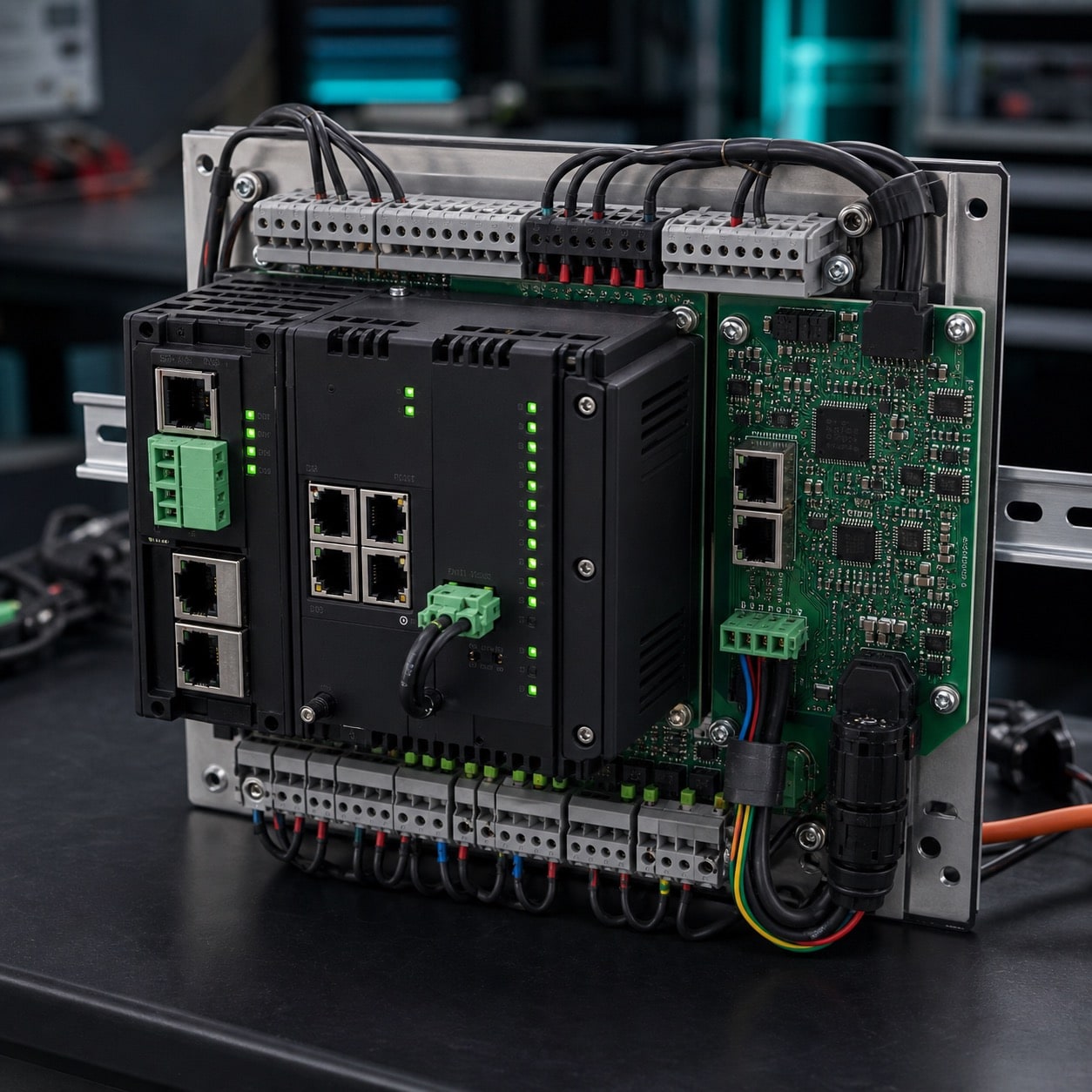
Hardware · DC Controller & PLC
Most charger problems aren't about the power electronics — they're about the brain. This is what we rebuilt.
Linux-based controller running our hardened charging stack. Real-time control plane to the power modules, supervisory plane to the CSMS, operator plane to the kiosk HMI.
Optional encrypted peer-to-peer mesh tunnel for support and diagnostics. No port forwarding, no static IPs, no cellular VPN bills. Toggle on only when needed.
Edit modules, OCPP profile, RFID, planner, PLC transport, authorization — and save without restarting the controller. Field-tunable in minutes.
Upload your logo and support phone. The kiosk and admin views rebrand immediately. OEM-ready on day one.
Activation codes are minted against the Linux device fingerprint. Codes for any other unit are rejected — refurb and clone protection without DRM friction.
Driver-based abstraction over power modules (LAN GenericKM2 BLN and others). Qualify two or three module vendors and source whichever wins each batch.
Every Joulepoint charger ships with a production-grade admin and kiosk HMI — no separate UI subscription, no third-party vendor portal. Below is what your operators get out of the box.
Single-pane controller / CSMS / PLC / network health, plus a live operations snapshot — the first thing your field engineer sees on every visit.
Live electrical values for every gun, session and auth state, planner context, vehicle demand — plus stop / clear-fault controls without leaving the kiosk.
Active and historical sessions with energy, power, duration, and per-row deep links. Built in, not a separate dashboard product.
Hot-reloadable site limit, OCPP SmartCharging integration, group power cap per PLC chain, cross-PLC borrowing toggle — editable without a controller restart.
Connector and PLC fault history with active vs resolved separation. No more digging through 30 MB log files to find what tripped the bay.
Edit modules, OCPP, RFID, planner, PLC transport, authorization — and save without restarting the controller. Field-tunable in minutes.
Upload your logo and support phone. The kiosk and admin views rebrand immediately. OEMs ship branded UI on day one.
Wi-Fi SSID scan + on-screen connect, wired primary device control, gateway and address visibility, plus a one-click Capture Diagnostic for field handoff.
Optional encrypted peer-to-peer mesh tunnel. The charger works fully without it — leave it off when you don't need remote access. No port forwarding, no static IP, no cellular VPN bill.
Per-chain health for every PLC chain in the cabinet — separate from controller health so you can isolate where a fault really lives.
Time-windowed runtime log access from the UI. Pair with Capture Diagnostic to ship an evidence bundle to engineering without SSH.
Health checklist plus operator-grade actions: Refresh Health, Recompute Planner, Restart Controller. No full reboot, no field engineer escalation.
Activation codes are minted against the Linux device fingerprint of that specific controller. Codes for any other unit are rejected — anti-counterfeit and refurb protection without DRM friction.
Driver-based abstraction over power modules. Qualify two or three vendors and source whichever wins each batch — no firmware change.
Live walkthroughs and screen recordings are available under NDA — talk to our sales engineering team.
Most charger problems aren't about the power electronics — they're about the controller, the HMI, the remote access, the licensing, and the lock-in. We rebuilt that whole layer.
Industry default — every parameter tweak means a field visit
Hot-reloadable Config Editor + Remote Tunnel: change driver, modules, OCPP profile, RFID, planner from anywhere, no controller restart.
Most CPOs pay $30–80 per charger per month for a managed APN + remote SSH
Built-in Tailscale mesh — peer-to-peer, encrypted, no port forwarding, no static IP. Toggle on only when support is needed.
Most charger controllers are hard-wired to one module brand
Driver-based module abstraction (we ship LAN GenericKM2 BLN and others). Source the cheapest qualified module without rewriting firmware.
Refurbed and grey-market chargers eat OEM margin
Per-device hardware-bound licence — activation codes are minted from a Linux device fingerprint; codes for any other unit are rejected.
Most OEMs ship a vendor HMI on top of someone else's controller
Production-grade admin HMI with white-label logo + support phone upload. OEMs ship a branded UI on day one.
Static splits waste headroom; live sharing usually needs a separate dispatcher box
Built-in site-aware planner: site limit + OCPP SmartCharging + group cap + cross-PLC borrowing — hot-editable from the UI.
Operators end up calling the OEM for every fault, every time
Fault Center, Refresh Health, Recompute Planner, Restart Controller — operator-grade actions in the UI, no SSH required.
Many OEM controllers only talk to that OEM's CSMS
Native OCPP 1.6J / 2.0.1 — point Charge-Point ID + CSMS URL at any CSMS (ours, AmpEco, Driivz, Monta, your own). Change it from the live config without firmware.
Concrete cost arguments by buyer persona. Numbers are mid-market estimates from public CPO operating benchmarks and our own deployments in India and Europe.
Cut remote-access spend
Tailscale's free / starter plans replace the typical cellular APN + VPN concentrator. For a 500-charger network this is $15k–$40k/year of OPEX gone, with stronger encryption than most managed APNs.
~$30–80 / charger / month saved
Kill truck-rolls for config
Every site visit costs ₹3,000–8,000 in fuel + engineer time in India, $100–400 in the EU/US. Hot-reload + remote tunnel removes 60–80% of those visits — the ones that exist today only to change a parameter or restart a process.
~60–80% of config-driven truck-rolls eliminated
Stop paying for a third-party HMI
Our kiosk + admin is included. No separate UI subscription, no per-charger licence on top of the controller, no $5–15/month-per-charger HMI vendor.
$60–180 / charger / year saved
Ship a branded controller on day one
Upload your logo + support phone, mint per-device licence codes from a fingerprint. Skip the 6–12 month effort of building your own admin HMI and licensing pipeline.
~6–12 months engineering avoided
Protect aftermarket revenue
Each activation code is bound to a specific Linux device fingerprint. Refurbished units can't be cloned, grey-market boxes can't bypass spare-parts revenue.
Refurb / grey-market arbitrage removed
Source modules competitively
The module abstraction lets you qualify two or three power-module vendors and quote whichever wins each batch — without firmware changes. Direct margin lift on every cabinet.
5–15% margin on power-module BOM
Most CPOs pay $30–80 per charger per month for a managed cellular APN plus a VPN concentrator just so engineering can SSH in. We replaced that with Tailscale's peer-to-peer encrypted mesh — the same technology used by enterprise infra teams. It costs almost nothing, encrypts end-to-end, requires no port forwarding, and the operator can revoke a key in a single click.
Charger ships with the tunnel OFF. The unit works fully without it.
When you need remote support, the operator turns the tunnel on from /admin/tunnel.
The shared key is minted by your support tenant — not by a third-party VPN vendor — so revocation is in your hands.
Tailscale connects engineer ↔ charger over its encrypted mesh. No port forwarding on the site router, no static IP, no SIM-card APN.
Disconnect, Logout (keep key), or Forget Key — three states the operator controls, all from the UI.
On first boot the controller derives a Linux device fingerprint. The Licence page shows it so you can copy it to your vendor support contact.
Support mints a 15-character code bound to that exact fingerprint. Codes for any other unit are rejected at activation.
Once active, every page shows a verified badge with activation date, stored code, and code file path.
Refurbished or grey-market units can't reuse another unit's code. Protects OEM aftermarket revenue without imposing DRM friction on the legitimate operator.
Each activation code is derived from the Linux device fingerprint of that specific controller. Refurbished units can't be cloned, grey-market boxes can't bypass spare-parts revenue, and the legitimate operator never has to deal with a network-call licence check.
The controller runs a site-aware planner that respects the contracted grid cap, OCPP SmartCharging profiles, group power caps per PLC chain, and cross-PLC borrowing — all live, all hot-editable.
Site limit (kW)
Hot-reloadable transformer/grid cap. Changes apply within ~50 ms.
OCPP SmartCharging limit
Respects active SmartChargingProfile from the CSMS.
Group power per PLC chain
Per-chain cap so a sticky vehicle doesn't starve siblings.
Cross-PLC borrowing
Optional — let an idle chain lend headroom to a busy one.
Live planner analytics
Requested / offered / allowed / assigned kW visible per cycle.
The PLC stack is observable, swappable, and tunable from the admin — not a black box. Each chain reports health separately so you can isolate a failed chain without guessing.
| Parameter | Value |
|---|---|
| Standard | HomePlug Green PHY · ISO 15118 PLC profile |
| Frequency range | 2–30 MHz |
| Data rate | Up to 10 Mbps typical |
| Per-cabinet chains | Multiple PLC chains supported, cross-PLC borrowing under planner control |
| Interface | Ethernet / CAN to the controller, PLC physical to the vehicle inlet |
| Power supply | 9–16 V DC |
| Operating temperature | −40 °C to 85 °C |
| Protection | Surge + ESD protected, conformal coated |
| Health visibility | Each PLC chain surfaces healthy / faulty separately to the admin Fault Center |
| Capability | Profile | Joulepoint |
|---|---|---|
| StartTransaction / StopTransaction | OCPP 1.6J | ✓ |
| Authorize / IdTag | OCPP 1.6J + 2.0.1 | ✓ |
| MeterValues + signed OCMF | OCPP 1.6J + 2.0.1 | ✓ |
| RemoteStart / RemoteStop | OCPP 1.6J + 2.0.1 | ✓ |
| SmartCharging (Profile) | OCPP 1.6J + 2.0.1 | ✓ planner-aware |
| FirmwareUpdate (signed) | OCPP 1.6J + 2.0.1 | ✓ signed + rollback |
| Diagnostics upload | OCPP 1.6J + 2.0.1 | ✓ Capture Diagnostic bundle |
| Security Profile 3 (TLS + cert) | OCPP 2.0.1 | ✓ TPM-backed |
| ISO 15118 PnC handshake | ISO 15118-20 | ✓ PKI provisioning |
| OCPI Locations / CDRs | OCPI 2.2.1 | ✓ via CSMS |
| Parameter | Value |
|---|---|
| Operating voltage | 9–36 V DC |
| Processor | ARM Cortex-A class (Linux) for supervisory + Cortex-M class for real-time |
| Interfaces | Ethernet, Wi-Fi, optional 4G/5G, CAN, RS485, USB |
| Protocols | OCPP 1.6J + 2.0.1, ISO 15118-20 (PnC), ISO 15118-2, DIN 70121, OCMF |
| Operating temperature | −40 °C to 85 °C |
| Security | TLS 1.3, OCPP Security Profile 3, per-device hardware-bound licence |
| I/O | 8 digital I/O, 4 analog inputs, dedicated charge-pilot lines |
| Firmware updates | Remote OTA (signed), with rollback + version pinning |
| HMI runtime | Embedded React HMI — admin + kiosk modes, white-label brandable |
| Remote access | Tailscale mesh tunnel (optional, encrypted, peer-to-peer) |
| Multi-connector | Up to N connectors per cabinet with shared power planner |
| Smart charging | Built-in site planner + OCPP SmartChargingProfile execution |
The controller speaks open standards. You can point it at Joulepoint software, third-party systems, or your own stack — change it from the live config without firmware.
Native pairing — chargers, sessions, plans, wallets, OCPI roaming all in one workspace.
Explore CSMS →Stream telemetry to the Edge platform for cross-asset analytics and alarms alongside meters, OBD, and site equipment.
Explore Edge →Native OCPP 1.6J + 2.0.1. Point Charge-Point ID + CSMS URL at AmpEco, Driivz, Monta, EVConnect, or your in-house stack — change it live from the config editor.
Tell us whether you're a CPO buying chargers or an OEM looking to white-label the controller. Our engineering team will scope the integration, licensing, and remote-access plan on the same call.